
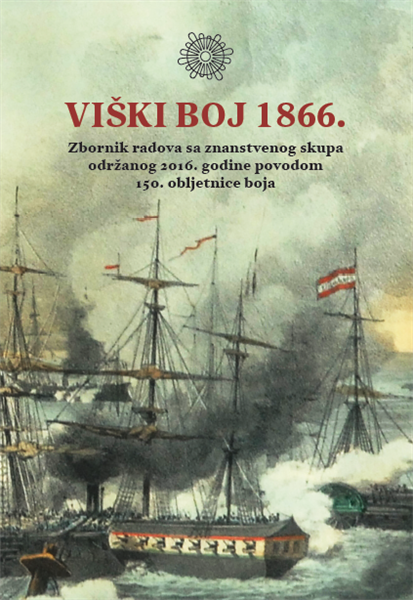
The University of Zadar has published a book of scientific papers titled “Viški boj 1866. Zbornik radova sa znanstvenog skupa održanog 2016. godine povodom 150. obljetnice boja,” edited by Mateo Bratanić. The topic of the famous naval battle that took place off the coast of Vis on July 20, 1866, has been a frequent subject of research and writing within Croatian, Austrian, Italian, and other European historiographies. The fact that the inferior Austrian fleet, led by Rear Admiral Wilhelm Tegetthoff, defeated the superior Italian fleet, led by Admiral Carlo Persano, has remained deeply rooted in the political, cultural, and social life of the latter half of the 19th and early 20th centuries. Not only were the Italian ambitions for the eastern Adriatic region temporarily thwarted, but an atmosphere of remembrance and celebration of this glorious victory was created, where Croatians, as skilled seafarers, also contributed.
The first comprehensive work, “The Battle of Vis” by Petar Kuničić, published in 1891, terminologically defined the battle, calling it “boj” (a term for a battle) as was customary in the periodicals and publications of that time. Since then, “boj” has been established in historiography as a term that, on the border of epic and science, emphasizes the significance of this conflict, simultaneously permeating the realm of public history as a “place of memory” within broader social awareness.
On the 150th anniversary of the battle, a conference was held in Vis and Komiža with twenty presentations that provided new scientific perspectives on the battle or addressed and presented topics for the first time that had not been previously approached scientifically. The Battle of Vis thus gained new value beyond the classical historiographical perspective of military and naval history, being placed in the context of geopolitics, memory studies, art history, literary history, archaeology, technological development, historical demography, and tourism development. This new edition’s novelty lies precisely in these areas, with fifteen scientific papers breaking the shell of classical historiography, approaching the research of the battle interdisciplinarily, and introducing new ideas and dimensions, confirming that an event from 1866 can still be highly relevant today for understanding broader political and social relations, as well as a stimulus for economic and tourist development.
 Dr Mateo Bratanić - Associate Professor